
How to Conduct a Systematic Review: A Stepwise Practical E-book

A systematic review is still one of the highest levels of evidence a research team can produce. It is also one of the easiest projects to stall: the question is too broad, the search is not reproducible, screening takes months, extraction fields do not match the analysis, and the Methods section no longer matches what the team actually did.
High Yield Med already publishes practical pieces on this path — including a systematic review protocol template and tools for sample size in a meta-analysis. What was missing was a single, free walkthrough of the whole review: question, search, screening, extraction, synthesis, meta-analysis, and writing.
That walkthrough is now live as the AIPRA Systematic Review E-book.
Read it here: https://aipra.co/systematic-review-ebook
It is free. No signup is required to read it. AIPRA (Artificial Intelligence Powered Research Automation) is High Yield Med’s flagship research platform; the e-book is the methodology companion to that workflow.
Who this is for
- Clinicians and domain experts running a first or second systematic review
- Methods leads and librarians who want a shared language with the rest of the team
- Students who need a stepwise map before they open PROSPERO or start screening
- Teams already using AIPRA who want the why behind each screen in the product
The e-book is not a substitute for the Cochrane Handbook or for an information specialist. It is a practical path through the decisions those sources expect you to make.
How the e-book is organized
There are eight chapters, in the same order as a real review.
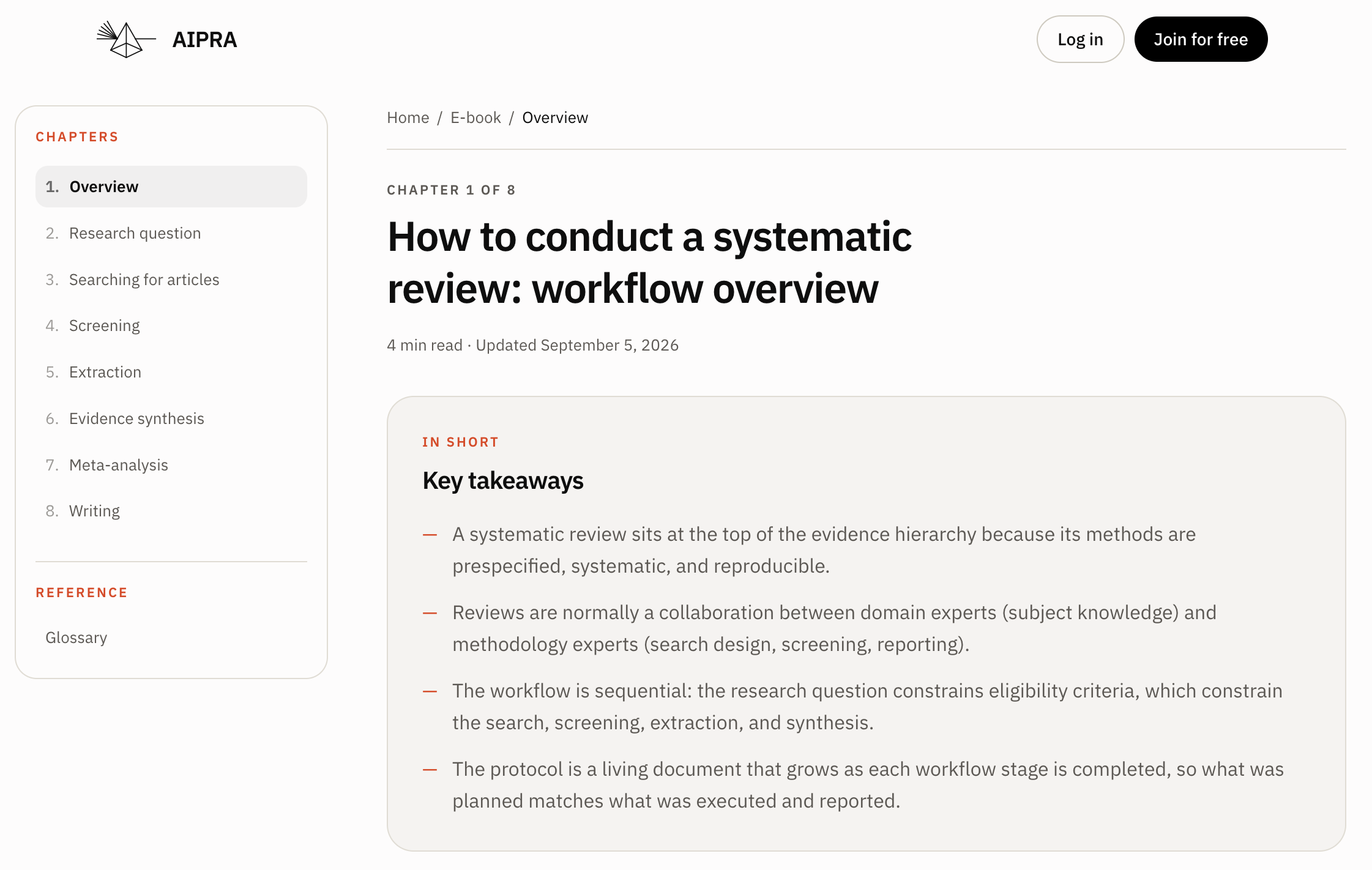
Each chapter depends on the one before it, so the protocol, the work, and the final paper tell the same story.
1. Overview
What a systematic review is, who usually leads it, and why the protocol should grow as you complete each stage rather than being written once and forgotten.
2. Research question
How to frame a question that can actually drive search and screening. For quantitative clinical reviews, that usually means PICO (Population, Intervention, Comparison, Outcome). The chapter also covers SPIDER (qualitative and mixed methods), PEO (exposures and experiences), and SPICE (social sciences). It is explicit about team size: plan for at least two independent reviewers plus a third to adjudicate. Single-reviewer screening is a rapid-review compromise, not the same as a full systematic review.
3. Searching for articles
Database choice, why you should search at least two independent bibliographic sources, and how to turn concepts into a Boolean query. It covers synonym expansion, controlled vocabulary (MeSH in PubMed, Emtree in Embase), grey literature, and deduplication on identifiers such as DOI and PMID. The chapter also points to the Cochrane Handbook section on duplicate reports.
4. Screening
Inclusion and exclusion criteria come first. Screening then happens in two phases: title and abstract, then full text for anything marked include or unclear. The chapter covers dual independent review, predefined conflict resolution (typically a third senior reviewer), and how AI recommendations can support consistency without replacing the protocol.
5. Extraction
Define the fields before you open PDFs. Those fields are what your results tables can later support. Dual extraction with reconciliation is the quality standard. If software proposes a value, it should point to the exact passage it came from — and a human should still confirm numbers, outcomes, and design details.
6. Evidence synthesis
The decision is not “meta-analysis versus a paragraph.” It is whether included studies are similar enough in PICO for a pooled estimate to be meaningful. When they are not — or when outcomes are too incompletely reported to pool — use a structured narrative synthesis and follow SWiM (Synthesis Without Meta-analysis). Heterogeneity statistics are rules of thumb, not hard cut-offs.
7. Meta-analysis
A concise methods tour: putting studies on a common scale (SMD or Hedges’ g for continuous outcomes; odds ratios or relative risks for binary outcomes), Cochran’s Q and I², random-effects versus fixed-effect models, forest plots, and funnel plots / Egger’s test for small-study effects. The default for most contemporary reviews is a random-effects model. Always extract sample size and a measure of precision; without those, pooling is not defensible.
8. Writing
Methods as a reproducibility blueprint: PROSPERO (or equivalent) registration, material deviations, full search strings, PRISMA-S for search reporting, a named risk-of-bias tool (for example RoB 2), and a PRISMA 2020 flow diagram whose counts match the text. If you used AI at any stage, say so — tool, version, which tasks, and the human oversight plan.
A glossary of the methodological terms sits beside the chapters, so PICO, I², SWiM, and PRISMA-S can be looked up without leaving the guide.
How to use it on a live project
A useful way to read the e-book is not cover-to-cover on day one. Use the chapter that matches the stage you are in:
- Lock the question and the team before you write a search.
- Translate the question into concepts, then into per-database queries. Run those queries in the native interfaces (PubMed, Embase, and so on) and keep the exports.
- Screen against written criteria, in two phases, with a conflict rule decided in advance.
- Extract only the fields your synthesis will use.
- Decide narrative versus meta-analysis from similarity of studies, not from preference.
- Write Methods and Results so another team could reconstruct what you did. Generate the PRISMA flow diagram from the same counts you report.
If you want a publication-ready PRISMA 2020 figure without signing up, use the free PRISMA flow diagram generator. For the protocol document itself, the older HYM systematic review protocol template still works as a starting outline.
Where AIPRA fits — and where it does not
AIPRA implements this same sequence in software: question framing, search documentation, screening, extraction, synthesis planning, and manuscript drafting. AI can suggest concepts, queries, include/exclude decisions, and extraction values. Reviewers remain responsible for the protocol and the final calls.
That distinction matters for journals. Cochrane, the Campbell Collaboration, JBI, and the Collaboration for Environmental Evidence have a 2025 joint position on AI in evidence synthesis: name the tool, justify it, and keep human oversight. AIPRA’s research and validation page collects the citable studies, and there is a copy-paste AI disclosure paragraph if you used the platform in a review you intend to submit.
The e-book is written so it is useful even if you never open AIPRA. The methods are the product; the software is one way to execute them.
Start here
- E-book home: aipra.co/systematic-review-ebook
- Glossary: aipra.co/systematic-review-ebook/glossary
- Free PRISMA 2020 diagram tool: aipra.co/tools/prisma-flow-diagram-generator
- HYM protocol template: Systematic review protocol template
If you are planning a review for High Yield Medical Reviews, the e-book is a practical pre-protocol read: get the question, the search, and the screening rule straight before you register.